EN
 ES
Shopping Cart
Your Cart is Empty
$0.00
View Cart

Before reserving a training seat, find out what you will actually practice and how your work will be reviewed. These eight questions help medical professionals compare Endolift courses beyond the brochure.
An Endolift training checklist should verify what you will practice, who will supervise you, and how your readiness will be assessed. When comparing hands-on Endolift training, request the Endolift course agenda and participation details before paying a deposit.
A polished demonstration can show what an experienced clinician does. It cannot tell you how much individual practice, correction, or case discussion you will receive. The useful comparison is between the learning experiences each program commits to delivering.
Start by confirming your Endolift training eligibility. Once that is clear, use the questions below to evaluate the course itself.
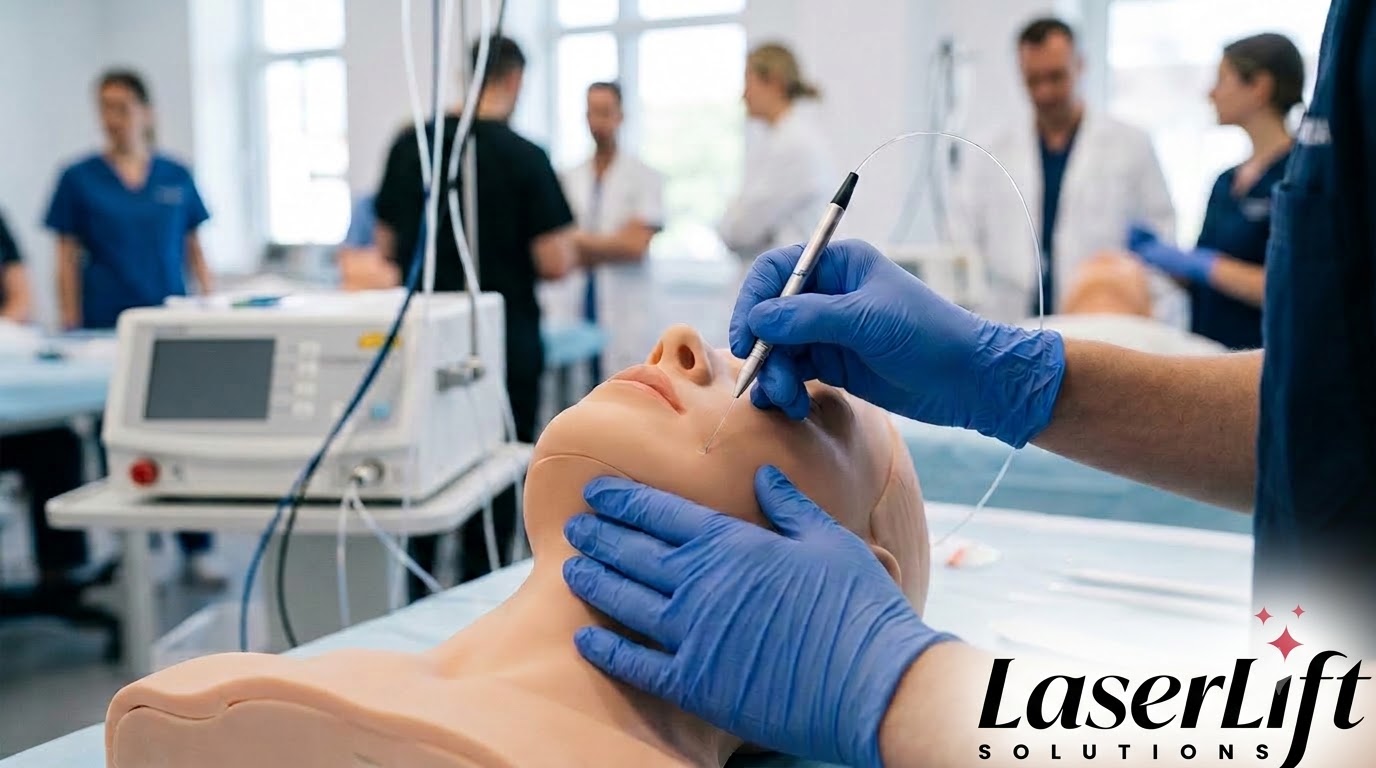
Ask the organizer to separate observation, simulation, and supervised clinical participation. “Live training” may describe a procedure you watch. “Hands-on” should come with a precise explanation of what participants can do and under what conditions.
Observation: Which parts of the consultation and procedure will you see, and when can you ask questions?
Simulation: Is there a defined exercise, and does the instructor review your performance?
Clinical participation: Which activities are available to you, subject to licensure, patient consent, and instructor approval?
ASLMS physician laser-training guidance addresses foundational study, practical sessions, clinical observation, and supervised experience. It offers a useful framework for asking about the learning format; it is not an Endolift-specific course endorsement.
Cohort size alone does not explain access. Ask how many instructors, devices, and suitable patient cases are planned, and how participants rotate through the session. A small group can still have limited participation if everyone shares one short demonstration.
Request the practical-session schedule rather than an estimate based on the total course length. Find out whether the instructor can observe each learner, give feedback, and allow time for questions.
Also ask what happens if a patient cancels or the planned clinical activities change. Is there an alternative learning activity, a replacement session, or a rescheduling policy? Patient suitability must guide the clinical day; the enrollment terms should explain how a changed schedule affects your training.
Find out whether the program documents attendance, assesses knowledge, evaluates practical skills, or combines these elements. Each tells you something different.
A useful answer should describe the task, who observes it, and how feedback is given. For example, will you explain your case assessment, discuss the limits of a proposed plan, and receive corrections? If a learner needs more practice, what is the next step?
Ask what you will take home: an assessment summary, individual learning priorities, case-discussion notes, or another record. Do not assume that receiving a certificate means every participant has demonstrated the same level of readiness.
Successful training should help you evaluate a patient before deciding to treat. Ask whether case discussions include unsuitable candidates, uncertain expectations, previous procedures, and situations that warrant referral.
Request examples of how the instructor explains a decision to defer treatment. A course that discusses only ideal cases leaves an important question unanswered: how will you recognize a patient whose needs exceed the procedure or your current experience?
Case exposure has a defined role in professional education. The ASLMS Preceptorship Program, for example, uses real-time clinical cases and treatment strategies to address practice gaps. When comparing courses, ask how the cases support the stated learning objectives.
Ask how the curriculum connects laser fundamentals, tissue interaction, clinical planning, and aftercare. Device operation should sit within a broader discussion of patient safety and professional judgment.
ASLMS safety resources cover education for physicians and staff, while its 2026 fundamentals course addresses core principles for clinical applications. These are useful references when checking whether a course agenda includes a clear safety component.
Ask which device and delivery system will be used, how manufacturer instructions are incorporated, and how the course teaches recognition and escalation of complications. Request the written curriculum rather than relying on a general promise that “safety is included.”
Eufoton’s published advanced EndoliftX masterclass agenda includes treatment precision, complex areas, and adjustments for tissue differences. It illustrates why you should check whether a course is designed for beginners or experienced users before comparing programs.
Ask for the credential’s exact title, issuing organization, completion requirements, and verification process. If the course advertises manufacturer recognition or continuing education credit, request the documentation for that specific claim.
Keep course completion, device authorization, and permission to practice separate. The FDA explains that it does not approve health care providers. An “FDA-approved provider” claim should therefore not be used as a training credential.
ASLMS guidance also treats training and institutional credentialing as separate matters. Confirm the requirements that apply to your license, location, facility, supervision arrangement, and insurance coverage before planning clinical implementation. An enrollment team’s acceptance does not settle all of those questions.
Ask what post-course support means in practical terms. Does it cover planned case review, curriculum questions, additional observation, or a return training session? Who responds, through which channel, and for how long?
Clarify whether support is individual or group-based, whether additional fees apply, and how patient information must be handled. A promise of “ongoing mentorship” is difficult to evaluate without those details.
Also ask how the program handles questions outside its support scope. Educational case discussion and urgent patient care need different response arrangements. Your practice should have its own appropriate escalation pathway.
Request a written breakdown of tuition, required preparation, materials, clinical participation, assessment, and follow-up support. Confirm which items cost extra, along with the deposit, cancellation, refund, and rescheduling terms.
If travel is involved, ask when the course date and your eligibility become final. Check whether device ownership or a separate purchase is required for attendance.
Compare the total commitment with your learning needs. A lower tuition does not automatically offer better value if it provides less supervised feedback or requires substantial extra training. A higher price also needs a clear explanation of the educational experience it includes.
Ask each program for the same information so that you can compare complete answers:
The current agenda, learning objectives, prerequisites, and named instructors.
The observation, simulation, and clinical participation available to your license type.
The practical-session schedule, supervision arrangements, and plan for clinical schedule changes.
The assessment method, credential issued, and any documented accreditation or manufacturer relationship.
The full tuition, enrollment policies, and defined post-course support.
These questions are an editorial decision framework, not a formal accreditation standard. Use the answers to identify which course fits your current experience and what further training you may need.
Explore the Laser Lift Solutions Endolift training program and request the current agenda, participation requirements, and next available course information. Explain your clinical background and the specific skills you want to develop so the team can discuss the appropriate training format.
Before reserving a seat, ask the training team to confirm your eligibility, available supervised participation, assessment, credential, and support in writing. Those details make the enrollment decision concrete.
No. A live demonstration can be observation only. Ask what each participant will personally practice, whether that involves simulation or clinical participation, and how supervision and feedback are provided.
Do not infer independent practice authority from a course certificate. Check the credential’s meaning and the requirements that apply to your license, jurisdiction, facility, and coverage. Training and credentialing are separate considerations.
Course length alone cannot establish readiness. Your prior experience, the curriculum, practical participation, assessment, and follow-up learning all matter. Ask how the program identifies learners who need additional supervised experience.
Ask the specific program. Course access, equipment purchases, and later clinical implementation may have different requirements. Get any purchase condition or device-related fee in writing before paying.
Do not assume it does. Request the exact credit type, accrediting organization, eligible professions, and completion requirements for the course you are considering.
Request an appointment here: https://mynuceria.com or call Nuceria Health at (305) 398-4370 for an appointment in our Miami office.
Check out what others are saying about our services on Yelp: Wellness Center in Miami, FL.