 EN
EN ES
ES
Shopping Cart
Your Cart is Empty
$0.00
View Cart

You catch your reflection in a store window. Or a photo comes back from a birthday dinner, and there it is.
Two soft creases run from the corners of your mouth down toward your chin. They give your whole face a tired, downturned look, even on a day you feel completely fine.
Marionette lines have a way of doing that. They show up gradually for years, then seem to arrive all at once.
Filler is usually the first fix people hear about. It's not the only one, and for a lot of patients, it's not the one they want to start with. Endolift takes a different route. Instead of filling in around the crease, it works on the skin and tissue that let the crease form in the first place.
The name comes from the hinged jaw on a wooden puppet. Once someone points out the resemblance, it's hard to unsee.
These lines run along a natural crease from the corner of the mouth down toward the jawline. On the surface, they look like a wrinkle. Underneath, something more layered is going on.
It's not just a line etched into the skin. It's a shift in the whole structure of the lower face.
Collagen and elastin decline steadily with age. That decline is what gives skin its bounce when we're younger, and its absence is what makes skin start to feel looser over time.
As that support fades, the tissue around the lower face and jawline begins to soften. It drifts downward, little by little.
At the same time, the fat pads in the mid-face shift position. That shift pulls the corners of the mouth down and deepens the crease that's already forming.
Sun exposure plays a role too, and so does genetics. Some people are simply built with a bone and tissue structure that shows these lines earlier than others.
Put it together, and marionette lines are really two problems happening at once: loss of tissue support, and a downward shift in position. Neither one is solved by filling a groove on the surface.
Filler still has a place in cosmetic care. For some patients, it's the right call, and it works well.
But more people are walking into consultations asking for something else. The reasons tend to repeat themselves.
Some have seen an overfilled look on someone they know, and they don't want that for their own face. Others are tired of the maintenance cycle: a touch-up every few months, forever.
And a good number just want a treatment that improves the skin itself, rather than adding volume on top of it.
That preference lines up with where the field has been heading. The Aesthetic Society has pointed to a broader shift toward subtler, more natural-looking outcomes. Endolift has been named among the treatments gaining ground for exactly this reason. It reads as refinement, not augmentation.
The distinction matters here in particular, because marionette lines are, at their root, a laxity problem. Filler can soften how the crease looks by adding volume underneath it. But it doesn't do anything for the loose, weakened tissue that let the fold form to begin with. Endolift goes after that tissue directly.
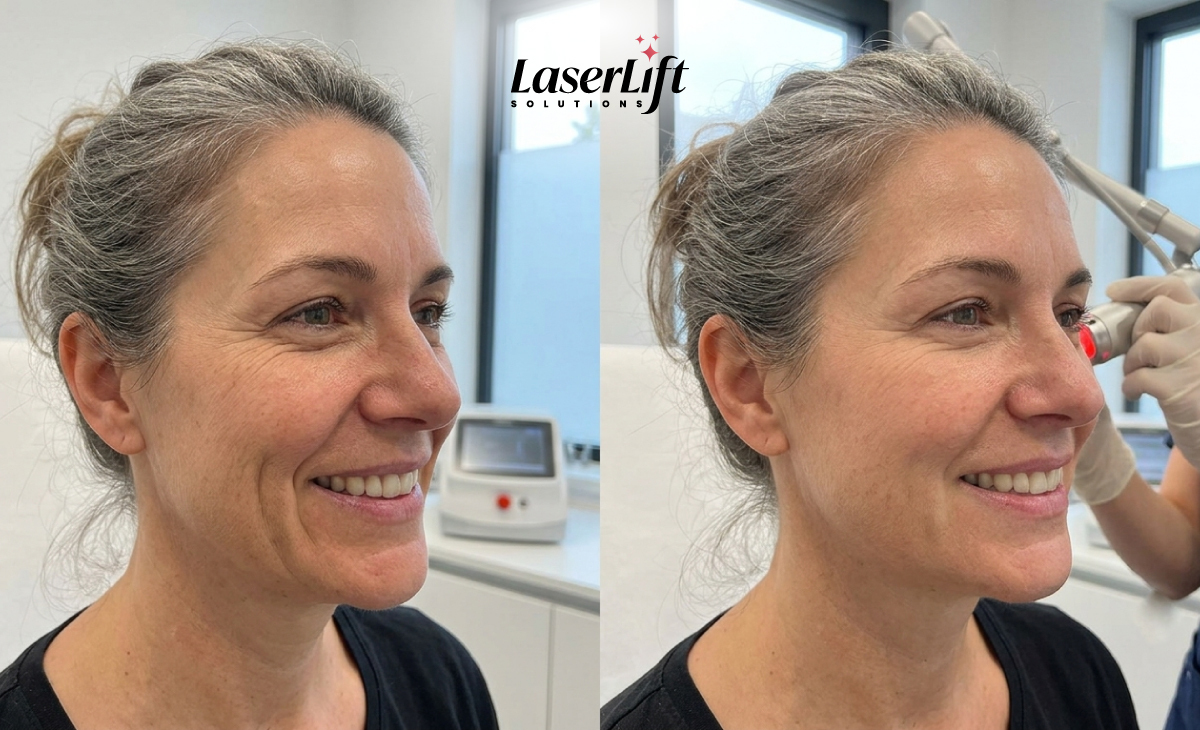
Endolift uses a fine optical fiber, roughly the width of a strand of angel hair pasta. It's inserted beneath the skin through a tiny entry point, so small it usually doesn't need a stitch.
That fiber delivers 1470nm laser energy straight to the deeper tissue layer.
The heat triggers new collagen production and tightens the fibrous bands that give the lower face its structure.
For marionette lines specifically, that means working on the support system around the mouth corners and jawline. Not the surface crease itself, but what's holding it in place from underneath.
Over the following months, that tissue firms up and contracts. The downward pull that created the fold starts to ease. The corner of the mouth reads as lifted, not filled.
This is the part worth being honest about, because overpromising helps no one.
Endolift tightens and lifts. It does not replace lost volume. If a patient has significant volume loss in the cheeks or lower face, filler may still have a role to play. In that case, Endolift can work alongside it rather than instead of it.
Where Endolift tends to shine is mild to moderate laxity. Patients who are just starting to notice early marionette lines, and who want to address the cause before reaching for volume, are usually good candidates.
Some patients use Endolift to delay filler for years. Others pair a smaller amount of filler with Endolift once the underlying tissue is firmer, which often means less product is needed to get a result that still looks like them.
The area is numbed first, so most patients describe the sensation as pressure and warmth rather than pain.
The fiber goes in through that tiny entry point. A session covering the lower face and mouth area typically runs 30 to 45 minutes.
There's no general anesthesia involved, and most patients are alert and comfortable enough to chat through the appointment.
Some mild swelling and light bruising in the days afterward is normal. It's part of the process, not a sign that anything went wrong.
Most people are back to their regular routine within a few days. Makeup can usually cover any visible bruising sooner than that.
Results build in gradually, not overnight. The most noticeable improvement tends to show up between three and six months after treatment, as new collagen continues to form.
That slower timeline is part of why the outcome tends to look like the patient, just firmer. Nothing changes abruptly, so nothing looks abrupt.
Endolift for marionette lines works best for mild to moderate laxity. If loose tissue is the main issue rather than significant volume loss, this is often the right first step.
It's not the right fit for everyone. Patients with more advanced volume loss usually need a broader plan, and that's a fair thing to find out before committing to anything.
Photos and self-assessment only tell part of the story. A hands-on evaluation is really the only reliable way to know where you fall.
Samantha Fonte, FNP-BC, has built a reputation as one of the country's top Endolift providers. That depth of experience is part of why other injectors travel to learn directly from her through the practice's hands-on training program.
If you're weighing Endolift against filler, or wondering whether your marionette lines are early enough for a laser-first approach, the team can walk you through it and look at your face specifically, not a generic case study. Take a look at the full menu of treatments offered at the practice, get to know the providers on the team page, or go ahead and book a consultation to start building a plan around your own face.
Yes. Endolift addresses the loose tissue and collagen loss that cause marionette lines to form, which works differently than filler's approach of adding volume under the crease. For mild to moderate laxity, it's often enough on its own.
Filler adds volume to soften how a crease looks. Endolift heats the tissue beneath the skin to rebuild collagen and tighten the structure causing the fold. One treats the cause, the other treats the appearance. They can also be combined when more volume support is needed.
It depends on what's driving the line. Mostly loose tissue and early laxity points toward Endolift as the better starting point. Significant volume loss in the surrounding area may call for filler as part of the plan, sometimes alongside Endolift rather than in place of it. A consultation is the most reliable way to know which situation you're in.
Most patients see results lasting two to three years. Some hold onto the improvement longer, depending on skin quality, sun habits, and how the face continues to age. Because the treatment stimulates the body's own collagen, results build in gradually rather than fading on a fixed schedule.
Ongoing collagen and elastin loss, sun exposure, and the natural downward shift of facial fat pads all play a part. Genetics and individual facial structure also influence how early and how deeply these lines tend to develop.
Request an appointment here: https://mynuceria.com or call Nuceria Health at (305) 398-4370 for an appointment in our Miami office.
Check out what others are saying about our services on Yelp: Wellness Center in Miami, FL.