EN
 ES
Shopping Cart
Your Cart is Empty
$0.00
View Cart

Acne scars and post-acne marks need different treatment plans. Compare how microneedling and chemical peels work, where each has limits, and what should guide your next step.
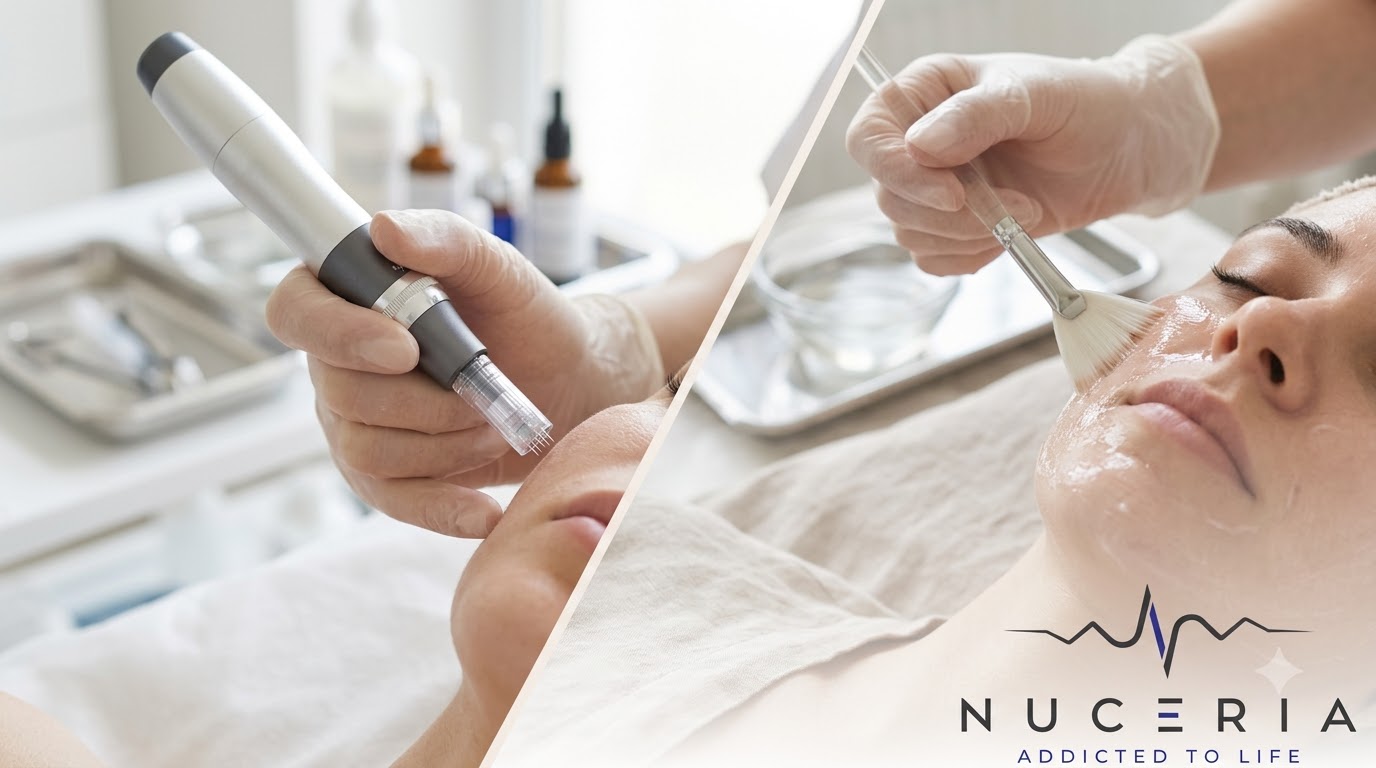
Microneedling vs. chemical peel for acne scars is a decision about texture, discoloration, and scar depth. Microneedling can help soften some depressed scars by stimulating collagen. Chemical peels can improve uneven tone and selected scars, depending on the peel. Neither treatment is the best choice for every mark left by acne.
Before booking, find out what you want to change: a flat dark spot, an indentation, a raised scar, or a combination. That distinction can prevent you from paying for a treatment that addresses the wrong concern.
A brown or gray spot that stays flat after a breakout may be post-inflammatory hyperpigmentation, often called PIH. It can look like scarring in a photo, but it does not create the same change in skin structure. The American Academy of Dermatology explains this difference in its acne scar overview.
If color is your main concern, ask about a pigment-focused plan. Choosing a collagen treatment simply because a dark mark is called an “acne scar” can miss the reason it is visible.
Indented, or atrophic, scars change the skin’s contour. Rolling scars create broad, uneven depressions; boxcar scars have more defined edges; ice-pick scars are narrow and deep. Raised scars, including keloids, involve a different healing pattern. The AAD’s scar classification guide shows why one treatment cannot address every scar type equally.
Conventional microneedling uses fine needles to create controlled punctures in the skin. The healing response stimulates collagen, which can make some acne scars less noticeable over time. Improvement develops gradually, rather than when redness first settles. The AAD’s microneedling guide describes its role in treating scars and uneven texture.
This article compares conventional microneedling with chemical peels. Radiofrequency microneedling adds energy and requires a separate discussion of its device, expected benefits, and risks.
A chemical peel applies a solution that removes selected layers of skin. The depth and formula affect what it can treat, how it heals, and its risks. Superficial peels can help uneven tone and some surface concerns. Selected peels can also reduce the appearance of acne scars, but a routine light peel should not be presented as a fix for every deep indentation.
The AAD’s chemical peel overview explains common treatment goals. For the broader mechanism, read how chemical peels renew and resurface skin.
|
Decision factor |
Conventional microneedling |
Chemical peel |
|
Main approach |
Controlled needle punctures to support collagen remodeling |
Chemical resurfacing at a selected depth |
|
Possible treatment role |
Selected depressed acne scars and uneven texture |
Discoloration, surface concerns, and selected scars |
|
Key limitation |
Does not correct every scar shape or depth |
Results and risks vary substantially by formula and depth |
|
Recovery |
Redness, sensitivity, and swelling can last several days |
Light peels heal sooner; deeper peels require longer recovery |
|
Best next question |
Which of my scars can this realistically improve? |
What exact peel and depth match my concern and skin tone? |
Use this comparison to organize a consultation. It does not establish that either procedure produces better results for every patient.
For depressed scars, a clinician may consider microneedling, a selected peel, or another scar procedure. Deep or tethered scars may require a different approach. The AAD’s acne scar treatment guide describes several options and explains why a plan may involve more than one treatment.
For flat dark marks, ask whether a topical regimen or an appropriately selected peel better addresses pigmentation. For a mix of dark marks and indentations, ask the provider to identify which part of the plan targets color and which targets contour.
An example: if your cheek has both brown spots and small depressions, brighter skin may make the area look more even while the indentations remain. Ask the clinician to define success for each concern before you compare packages.
Both procedures need individualized screening. Darker skin tones can develop pigment changes after inflammation. Microneedling may be an option, but the FDA notes that some authorized devices were not studied in darker skin types. For peels, choose a clinician experienced with your skin tone and the proposed depth. Ask how pigment changes would be prevented and managed.
If you still have inflamed breakouts, acne control usually comes before scar treatment. Treating old scars while new ones keep forming can undermine the result.
Bring a list of prescriptions, acne treatments, and skin care products. Disclose isotretinoin use, cold sores, prior pigment problems, and abnormal scarring. The AAD’s peel preparation guidance explains why this history matters. Your treating clinician should set any medication or skin care changes; do not stop prescribed treatment on your own.
Microneedling often requires a series. Changes may begin within weeks, with fuller improvement taking months. Redness, sensitivity, or swelling may last several days. A peel’s recovery depends strongly on depth: the AAD lists about 1–7 days of healing for a light peel and 7–14 days for a medium peel. Individual healing can differ.
In Miami, plan around beach days, outdoor workouts, travel, and any event where visible redness or flaking would be inconvenient. Ask for written sun-protection and aftercare instructions, including when to restart makeup, exfoliants, and exercise. A clinic should explain the recovery for your actual procedure, rather than promise “no downtime” for an entire treatment category.
Sometimes, but the protocol matters. A randomized trial involving 120 participants compared microneedling, a specific chemical peel, and their combination for atrophic acne scars. The combined group showed a statistically significant improvement in the scar score used in that study. That result does not prove that any peel can be paired with any device or that the same outcome applies to every patient.
Ask whether combination treatment is appropriate, what evidence supports the exact protocol, and how the timing affects healing. Avoid copying a combined treatment from a video or assuming that adding more procedures improves value.
A price for one peel and a price for one microneedling appointment do not necessarily describe comparable care. Request a written estimate covering the proposed series, follow-up, required products, and any maintenance. Ask when progress will be reassessed and what happens if the original plan does not meet your goals.
A useful consultation should explain what is likely to improve, what may remain, and when a referral is more appropriate. No fixed session count or scar-removal percentage can be promised from an online comparison.
My Nuceria offers microneedling in Miami and chemical peel treatments. Review the service information, then request an assessment of your skin texture, pigment concerns, acne history, and recovery needs. A consultation can help determine whether one of these services fits your goals or whether you need a different evaluation.
Book a skin consultation with My Nuceria or call (305) 398-4370. Bring your current skin care routine and a clear description of the change you want to see.
There is no universal winner. Microneedling can help selected depressed scars. A peel may address discoloration and selected scars, depending on depth. Scar type, skin tone, acne activity, and recovery needs should guide the choice.
Complete removal should not be promised. A selected peel may make some scars less noticeable, while deeper or raised scars may need another approach. Ask what change is realistic for each scar type.
First confirm that the marks are pigmentation rather than true scars. A clinician may recommend a topical plan, a selected peel, or another approach. The answer depends on the cause and your skin’s response to inflammation.
Yes. Darkening or lightening can occur, along with other risks. Discuss your skin tone, prior reactions, device, and aftercare with the provider. Treatment should use a new needle cartridge for each session.
Usually, active acne should be controlled first to reduce new inflammation and scarring. A dermatologist can coordinate acne management with a later scar plan.
This article provides general education. An examination and medical history are needed to determine which treatment is appropriate.
Request an appointment here: https://mynuceria.com or call Nuceria Health at (305) 398-4370 for an appointment in our Miami office.
Check out what others are saying about our services on Yelp: Wellness Center in Miami, FL.