 EN
EN ES
ES
Shopping Cart
Your Cart is Empty
$0.00
View Cart

You've done the serums, the retinol, maybe even Botox — and your jawline still isn't where you want it. Before you jump to a surgical facelift, two Miami-based options come up in almost every consultation: PDO thread lift and Endolift. They both promise lift without a scalpel, but they work in completely different ways, and picking the wrong one means paying for a result you didn't actually want.
Here's the real, no-fluff breakdown — including which one wins for jowls, double chin, and marionette lines specifically.
Short version: PDO threads physically anchor and pull sagging tissue upward with suspended sutures. Endolift tightens from within using 1470nm laser heat that contracts and rebuilds collagen — no anchoring, no pulling, just controlled thermal remodeling.
|
PDO Thread Lift |
Endolift |
|
|---|---|---|
|
Mechanism |
Barbed/mono sutures that suspend sagging tissue |
Micro-thin optical fiber delivering laser energy under the skin |
|
Visible result |
Immediate lift, same day |
Gradual — builds over 3–6 weeks as collagen matures |
|
Longevity |
4–6 months for the suture, secondary collagen effect up to ~1–2 years |
2+ years with proper skincare |
|
Downtime |
Minimal; some tenderness or bruising near barbed areas |
Minimal; mild redness for 24–48 hours |
|
Best suited for |
Jowls, sagging cheeks, nasolabial folds needing mechanical suspension |
Double chin, jawline definition, submental fat, skin laxity without true "hanging" tissue |
Neither replaces a surgical facelift for severe laxity — but for mild to moderate sagging, one of these (or both, staged together) solves it for most patients we see in Miami.
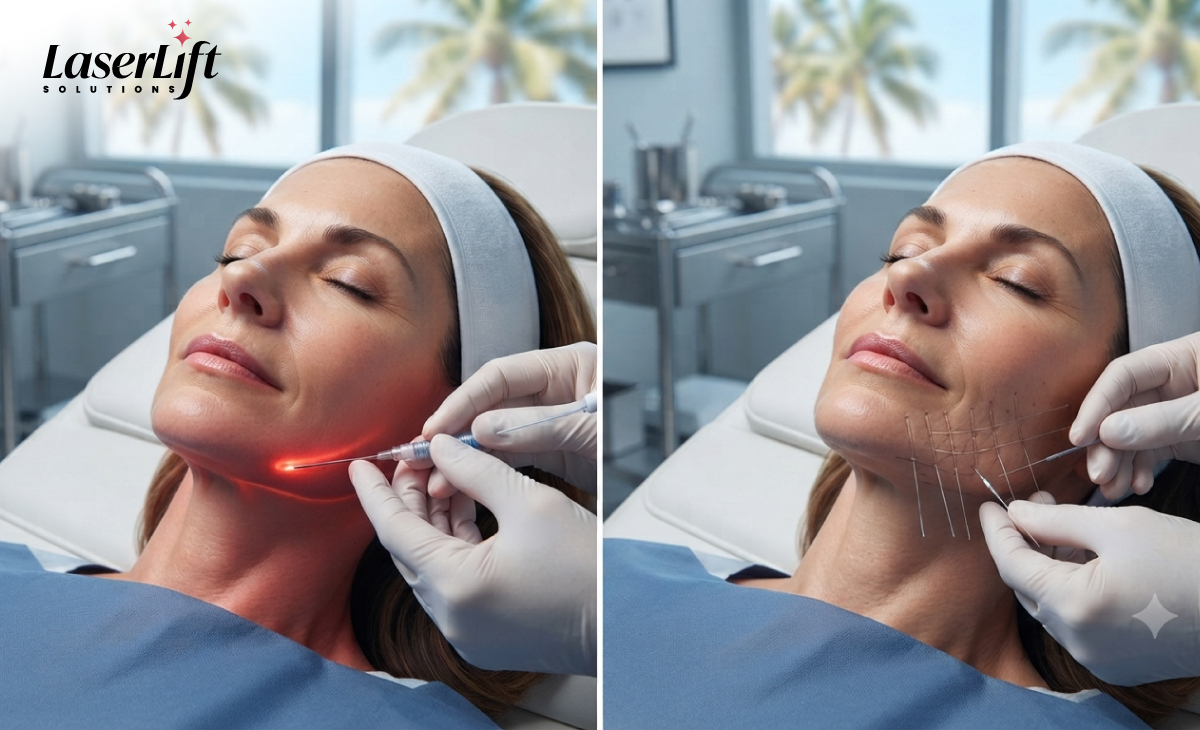
PDO thread lifts work like tiny internal scaffolding. A provider threads dissolvable polydioxanone sutures under the skin using a cannula or fine needle. Depending on the type — mono, cog, or screw threads — they serve different jobs: mono threads stimulate collagen without lifting anything, cog threads have barbs that literally hook into tissue and suspend it, and screw threads restore volume in hollowed areas. It's a mechanical fix: the thread holds the tissue in place while the body heals around it.
Endolift takes the opposite approach. A hair-thin optical fiber enters through a nearly invisible access point and delivers 1470nm laser energy directly into the deep dermis. That heat contracts existing collagen fibers on contact and triggers neocollagenesis — forcing the skin to manufacture new collagen over the following months. There's no suture holding anything up; it's the skin itself, now denser and more organized, doing the work.
In plain terms: threads are structural support. Endolift is cellular reprogramming.
With PDO threads, you see the lift the moment you leave the chair — that's the appeal if you have an event coming up. But the suture material dissolves within 4 to 6 months, and while the secondary collagen boost can extend the visual effect somewhat, the mechanical suspension itself typically holds for one to two years depending on thread type and treatment area.
Endolift plays a longer game. There's no dramatic "before and after" the day you walk out — results build gradually over 3 to 6 weeks as new collagen matures. The payoff: because it doesn't rely on a material that eventually breaks down, the firmness tends to hold longer — two years or more with consistent sun protection and skincare.
Need something for a wedding next month? Threads win that race. Thinking three years out? Endolift usually outperforms.
Recovery is close to a tie. Both are in-office procedures done under local anesthesia, and most patients resume normal activity the same day or the next. With threads, expect slightly more tenderness or minor bruising near barbed insertion points, especially along the jawline where there's more movement. With Endolift, the most common side effect is mild redness that fades within 24–48 hours.
Cost depends entirely on how many areas need treatment and how many threads or fiber passes your case requires — there's no flat rate that applies across patients. The honest way to know what makes sense for your budget is a real evaluation. Check the Endolift FAQs for procedure specifics, or go ahead and book your consultation so we can assess your skin in person and give you an actual number — not a generic estimate.
This is where the decision actually gets made, and it has less to do with trends and more to do with what's happening in your tissue:
Visible jowls or sagging mid-face that needs mechanical suspension → PDO threads are the more direct tool.
Double chin, soft jawline, or lost definition without true "hanging" skin → Endolift wins because it contracts tissue and reduces small fat pockets at the same time.
Thin or reactive skin → Endolift tends to be more predictable since it doesn't depend on how your body heals around a foreign material.
Immediate result for an event → Threads, by mechanism of action, get there faster.
There's no universal "best non-surgical jawline lift" — there's the best option for your specific anatomy, and that only gets determined in person.
Yes — and it's one of the most-requested combinations we see in clinic. Threads deliver immediate suspension while Endolift works in the background rebuilding collagen; by the time the thread material dissolves months later, the skin already has a stronger collagen foundation holding the result in place. It's sequencing, not competition.
This is exactly the kind of combination protocol we build into Skin Reaper, our Endolift + Biofiller package, designed for patients who want a visible result now and sustained renewal over the following months.
Want to see the actual procedure before deciding? Watch the process here.
Does a PDO thread lift hurt more than Endolift?
Both are done under local anesthesia, so pain during the procedure is minimal either way. Afterward, barbed threads can leave more tension or tenderness for a few days, while Endolift usually causes only mild, short-lived redness.
Can I get PDO threads and Endolift in the same session?
It's possible, but most providers space the two out by a few weeks so the skin isn't hit with two regenerative triggers at once. Your provider determines the order and timing based on your skin.
Which lasts longer, PDO threads or Endolift?
The thread material itself dissolves in 4 to 6 months, though the collagen effect can stretch a bit further. Endolift, since it doesn't rely on a dissolvable material, typically holds firmness for two years or more with proper skincare.
I have significant sagging — will either of these work?
If laxity is severe, neither threads nor Endolift will match what a surgical facelift can do. Both are built for mild to moderate sagging; for more advanced cases, we'll tell you that honestly in consultation and walk through what actually makes sense.
Who decides which treatment is right for me?
That's determined in an in-person evaluation of your skin, anatomy, and goals. At Nuceria, the team led by Samantha Fonte assesses each case individually before recommending threads, Endolift, or a combination of both.
Ready to find out which one is right for you? Book your consultation and we'll figure it out together — no guesswork.
Request an appointment here: https://mynuceria.com or call Nuceria Health at (305) 398-4370 for an appointment in our Miami office.
Check out what others are saying about our services on Yelp: Wellness Center in Miami, FL.