 EN
EN ES
ES
Shopping Cart
Your Cart is Empty
$0.00
View Cart

Regulatory status note: This article reflects FDA information available as of July 16, 2026, before the Pharmacy Compounding Advisory Committee meeting scheduled for July 23–24, 2026. The committee provides nonbinding advice. The FDA has stated that it will not make a final determination until the advisory process and its reviews are complete.
The phrase “FDA-approved peptide” is often used too loosely. It can refer to an active ingredient contained in an approved medication, a finished prescription drug approved for a defined use, or a substance being used in a compounded preparation. Those are three different regulatory situations.
The FDA approves specific drug products. That approval is tied to a defined active ingredient, formulation, strength, route of administration, manufacturing process, labeling, and medical indication. It does not automatically extend to every product carrying the same ingredient name, every compounded version, or every proposed use.
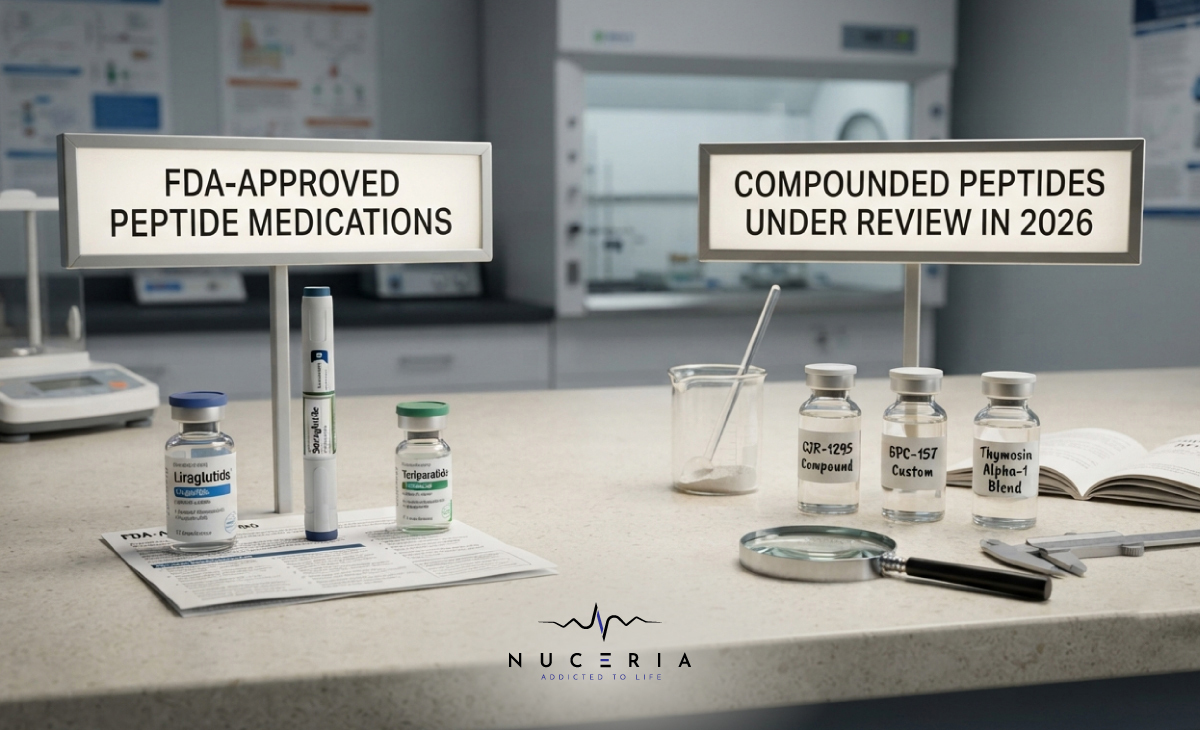
Several peptide-based active ingredients are components of FDA-approved medications. Examples include semaglutide, tirzepatide, liraglutide, tesamorelin, teriparatide, and teduglutide when supplied as approved products for their labeled indications. The list is not exhaustive.
By contrast, BPC-157, KPV, TB-500, and MOTS-c are not components of FDA-approved drugs, according to the FDA’s individual 2026 briefing documents. Emideltide, also called DSIP, Epitalon, and Semax are likewise not components of FDA-approved drugs.
That distinction is central to understanding the FDA’s July 2026 review.
Section 503A establishes conditions under which licensed pharmacists and physicians may prepare certain compounded drugs for individual patients. When no applicable United States Pharmacopeia or National Formulary monograph exists, a bulk substance generally must either be a component of an FDA-approved drug or appear on the 503A Bulks List.
Inclusion on that list concerns whether a substance may be used in qualifying compounding under specified legal conditions. It is not a finding that a finished compounded product has passed the FDA’s conventional premarket review.
|
Regulatory category |
What it means |
What it does not mean |
|
FDA-approved drug product |
The FDA has reviewed a specific product for quality, safety, effectiveness, manufacturing, and labeled use |
Every formulation or use of the ingredient is approved |
|
Substance on the 503A Bulks List |
The substance may be eligible for use in qualifying patient-specific compounding when statutory conditions are met |
The substance or resulting compounded product is FDA-approved |
|
Compounded drug |
A preparation made for a patient whose clinical needs may not be met by an approved product |
The FDA has independently approved its safety, effectiveness, or quality |
The FDA’s Section 503A bulk drug substance framework describes the ingredient conditions that apply to this category of compounding.
The agency is equally direct about the finished preparations: FDA guidance on compounded drugs states that compounded drugs are not FDA-approved and do not undergo the agency’s premarket verification of safety, effectiveness, and quality. Compounding can meet a legitimate clinical need, but it is not a substitute term for FDA approval.
The following are selected examples of peptide-based active ingredients contained in FDA-approved drug products. This is not a complete list, and every approval remains product- and indication-specific.
|
Active ingredient |
FDA-approved product example |
Selected approved use |
|---|---|---|
|
Semaglutide |
Long-term weight management in qualifying patients; additional product-specific indications are defined in the current labeling |
|
|
Tirzepatide |
Long-term weight management in qualifying adults and treatment of moderate-to-severe obstructive sleep apnea in adults with obesity |
|
|
Liraglutide |
Long-term weight management in eligible adults and adolescents |
|
|
Tesamorelin |
Reduction of excess abdominal fat in adults with HIV-associated lipodystrophy |
|
|
Teriparatide |
Treatment of osteoporosis in specified patients at high risk for fracture |
|
|
Teduglutide |
Short bowel syndrome in adults and pediatric patients at least one year old who depend on parenteral support |
Current FDA labeling supports these product-specific indications.
An active ingredient may appear in several approved products with different indications.
Semaglutide is one example. Wegovy has weight-management indications, while Ozempic and Rybelsus have product-specific indications centered on type 2 diabetes and related outcomes. Tirzepatide provides another example: Zepbound has approved weight-management and obstructive sleep apnea indications, while Mounjaro is approved to improve glycemic control in patients with type 2 diabetes who meet its labeling criteria.
The presence of the same nonproprietary ingredient name does not make these products interchangeable for marketing, prescribing, dosing, or regulatory purposes.
Tesamorelin is sometimes grouped into broad discussions about body composition or fat reduction. Its FDA-approved indication is much narrower: reducing excess abdominal fat in adults with HIV-associated lipodystrophy.
That approval does not establish tesamorelin as an approved treatment for general obesity, routine weight loss, bodybuilding, or cosmetic abdominal-fat reduction.
An FDA-approved branded or generic drug and a compounded preparation are not equivalent regulatory categories.
A compounded preparation containing semaglutide, tirzepatide, or another active ingredient is not transformed into an FDA-approved product merely because an approved drug contains a similarly named ingredient. The finished compounded preparation has not undergone the same product-specific FDA review.
The agency’s guidance on unapproved GLP-1 drugs used for weight loss specifically warns that unapproved versions do not receive FDA premarket review for safety, effectiveness, or quality. The FDA also cautions against marketing that presents a compounded drug as equivalent to an approved product.
The substances on the July 2026 agenda are often discussed collectively as “wellness peptides.” That label obscures substantial differences in their proposed uses, chemistry, evidence, and potential risks.
The FDA evaluates these substances individually using four broad criteria:
Physical and chemical characterization.
Safety issues associated with compounded use.
Available evidence of effectiveness or lack of effectiveness.
Historical use in compounded drug products.
The agency balances these factors rather than treating online demand, anecdotal popularity, or theoretical mechanism as proof of clinical benefit.
BPC-157 is being evaluated in relation to ulcerative colitis. KPV is being considered for wound healing and inflammatory conditions, while TB-500 is being evaluated for wound healing.
The FDA briefing documents state that none of these substances, in the forms under review, is a component of an approved drug. The agency’s analyses also identify recurring concerns involving chemical characterization, limited or absent human evidence, unknown safety profiles, aggregation or immunogenicity questions, and the availability of approved treatments for the medical conditions under consideration.
For BPC-157 specifically, the FDA describes uncertainty over whether products marketed under the common name refer to the free base, acetate, or another related material. That is not a minor labeling issue. Different active pharmaceutical ingredients can have different chemical, pharmacologic, and safety characteristics.
MOTS-c is scheduled for discussion in relation to obesity and osteoporosis. It is not an FDA-approved obesity medication and is not a component of an FDA-approved drug.
The FDA’s briefing document reports insufficient human safety and effectiveness information for the proposed uses. It also notes unresolved immunogenicity questions and the existence of FDA-approved therapies for weight reduction and osteoporosis. The agency’s current proposal is not to add either MOTS-c free base or MOTS-c acetate to the 503A Bulks List.
This is a materially different position from the approval status of products such as Wegovy, Zepbound, or Saxenda. Those products were reviewed through formal drug applications with product-specific clinical, manufacturing, and labeling data.
Emideltide, also known as DSIP, is being evaluated for opioid withdrawal, chronic insomnia, and narcolepsy. Semax is being evaluated for cerebral ischemia, migraine, and trigeminal neuralgia. Epitalon is being evaluated for insomnia.
The FDA’s briefing documents state that none of these free-base or acetate forms is a component of an approved drug. The agency’s current proposal is not to place any of them on the 503A Bulks List.
That proposal does not prevent future research. It means that, based on the information reviewed for this regulatory process, the FDA does not currently believe the criteria support their inclusion on the list.
Approved GLP-1 and dual GIP/GLP-1 products have defined formulations, dosing schedules, contraindications, warnings, storage requirements, and manufacturing controls. These details are part of the approved application and labeling.
Compounded products may differ in concentration, container, dosing units, excipients, storage, delivery device, or source of active pharmaceutical ingredient. Those differences can become clinically significant, particularly when patients measure doses from multidose vials rather than use a manufacturer-controlled delivery system.
The FDA has reported concerns involving dosing errors, use of doses outside approved labeling, fraudulent product labels, improper refrigeration, and semaglutide salt forms that differ from the active ingredient used in approved drugs. The agency states that semaglutide sodium and semaglutide acetate are different active ingredients from those used in approved semaglutide products and that it is not aware of a lawful basis for their use in compounding.
This does not mean that every compounded preparation is automatically inappropriate. It means the medical reason for compounding, the identity of the compounder, the exact ingredient, the concentration, the dosing instructions, and the applicable federal and state requirements must be evaluated rather than assumed.
“Peptide” describes a molecular category. It does not tell a patient whether a treatment is approved, appropriate, effective, or safe for a particular diagnosis.
A credible treatment decision begins with the patient’s health status, medical history, current medications, contraindications, relevant laboratory data, body composition, nutritional intake, and treatment objectives.
For patients considering evidence-based metabolic care, Nuceria Health’s medical weight loss programs in Miami begin with a medical evaluation and may incorporate blood testing, body-composition analysis, nutrition planning, exercise planning, and ongoing monitoring.
That structure is more clinically useful than selecting a medication or peptide based on social-media visibility or a generalized promise of faster results.
Medication can affect appetite, food intake, gastrointestinal tolerance, hydration, and lean-mass preservation. A prescription alone does not resolve dietary quality, protein intake, meal structure, behavioral adherence, or the conditions that contributed to weight gain.
A personalized nutrition program in Miami can support dietary assessment, measurable goal setting, food tracking, meal planning, and adjustments based on progress. These elements remain relevant whether a patient qualifies for medication or follows a non-pharmacologic plan.
Appropriate testing can identify relevant health factors, establish baseline measurements, and support follow-up. Patients can review available laboratory testing options as part of a clinician-directed evaluation.
Laboratory monitoring does not turn an unapproved substance into an approved drug. It also cannot independently verify that a compounded product has the identity, purity, potency, sterility, or stability represented by its seller.
Before treatment, patients should know:
The exact generic and brand name, when applicable.
Whether the finished product is FDA-approved or compounded.
The labeled or proposed medical indication.
The strength, concentration, dose, and route.
The prescribing clinician and dispensing pharmacy.
Why a compounded preparation is being considered instead of an approved product.
What monitoring, adverse effects, contraindications, and stopping criteria apply.
A vague description such as “medical-grade peptide” or “the same ingredient as the approved drug” is not sufficient product identification.
A productive clinical discussion should answer seven questions.
Is this exact finished product FDA-approved?
The answer should distinguish an approved brand or generic product from a compounded preparation.
Is it approved for the condition being treated?
Approval of a drug for one indication does not establish approval for every off-label or wellness use.
Why is this treatment being recommended for me?
The rationale should be based on diagnosis, medical history, risk, evidence, and realistic objectives.
Is an FDA-approved alternative available?
When an approved product can meet the patient’s needs, the clinical reason for using a compounded alternative should be clear.
Who manufactured or compounded the product?
Patients should be able to identify the licensed prescriber, dispensing pharmacy, and product source.
How will effectiveness and safety be monitored?
Monitoring should be linked to measurable clinical outcomes rather than subjective promises of optimization.
What happens if the treatment is ineffective or poorly tolerated?
The plan should include dose-management rules, warning symptoms, follow-up timing, and discontinuation criteria.
The FDA advises patients to obtain prescriptions through licensed clinicians, use appropriately licensed pharmacies, and discuss medication questions with a qualified healthcare professional.
FDA-approved peptide-based medications already exist. Semaglutide, tirzepatide, liraglutide, tesamorelin, teriparatide, and teduglutide are examples of active ingredients found in approved products for specific medical indications.
That does not mean every peptide is approved. It also does not mean every preparation containing an approved active ingredient has FDA approval.
BPC-157, KPV, TB-500, MOTS-c, emideltide or DSIP, Semax, and Epitalon are not components of FDA-approved drugs in the forms being reviewed. The July 23–24, 2026 meeting concerns whether their free-base and acetate forms should be included on the 503A Bulks List for compounding. The FDA’s preliminary proposal is not to include any of the 14 forms, but the agency has not yet completed the process or issued its final determination.
Patients should evaluate the exact product, indication, evidence, pharmacy, prescriber, and monitoring plan—not the marketing appeal of the word “peptide.”
No. The FDA’s 2026 briefing document states that neither BPC-157 free base nor BPC-157 acetate is a component of an FDA-approved drug. The agency is proposing that neither form be added to the 503A Bulks List. That proposal is not yet a final determination.
No. MOTS-c is not a component of an FDA-approved drug and does not have an FDA-approved obesity or weight-loss indication. Obesity and osteoporosis are the uses being evaluated during the July 2026 compounding review.
No. The FDA’s individual briefing documents state that the free-base and acetate forms under review are not components of FDA-approved drugs.
The meeting is not a conventional drug-approval hearing. The committee will advise the FDA about possible inclusion on the 503A Bulks List. Its recommendations are nonbinding, and the FDA will make any final determination after considering the committee process and completing its reviews.
No. Inclusion may allow a bulk substance to be used in qualifying patient-specific compounding under Section 503A. The resulting compounded drugs are not FDA-approved and do not undergo the FDA’s standard premarket review.
FDA-approved product examples include Wegovy, which contains semaglutide; Zepbound, which contains tirzepatide; and Saxenda, which contains liraglutide. Eligibility, dosing, contraindications, and approved populations differ by product and must be evaluated according to current prescribing information.
No. FDA-approved products containing semaglutide or tirzepatide exist, but compounded versions are not FDA-approved. The FDA does not conduct premarket review of compounded versions for safety, effectiveness, or quality.
No. Tesamorelin has an approved product-specific indication for reducing excess abdominal fat in adults with HIV-associated lipodystrophy. That approval does not cover general obesity treatment or routine cosmetic weight loss.
No. Testing can help clinicians evaluate a patient and monitor selected health markers. It does not establish that an unapproved or compounded product has been proven safe and effective, nor does it confirm the product’s manufacturing quality, purity, potency, or sterility.
Request an appointment here: https://mynuceria.com or call Nuceria Health at (305) 398-4370 for an appointment in our Miami office.
Check out what others are saying about our services on Yelp: Wellness Center in Miami, FL.