 EN
EN ES
ES
Shopping Cart
Your Cart is Empty
$0.00
View Cart

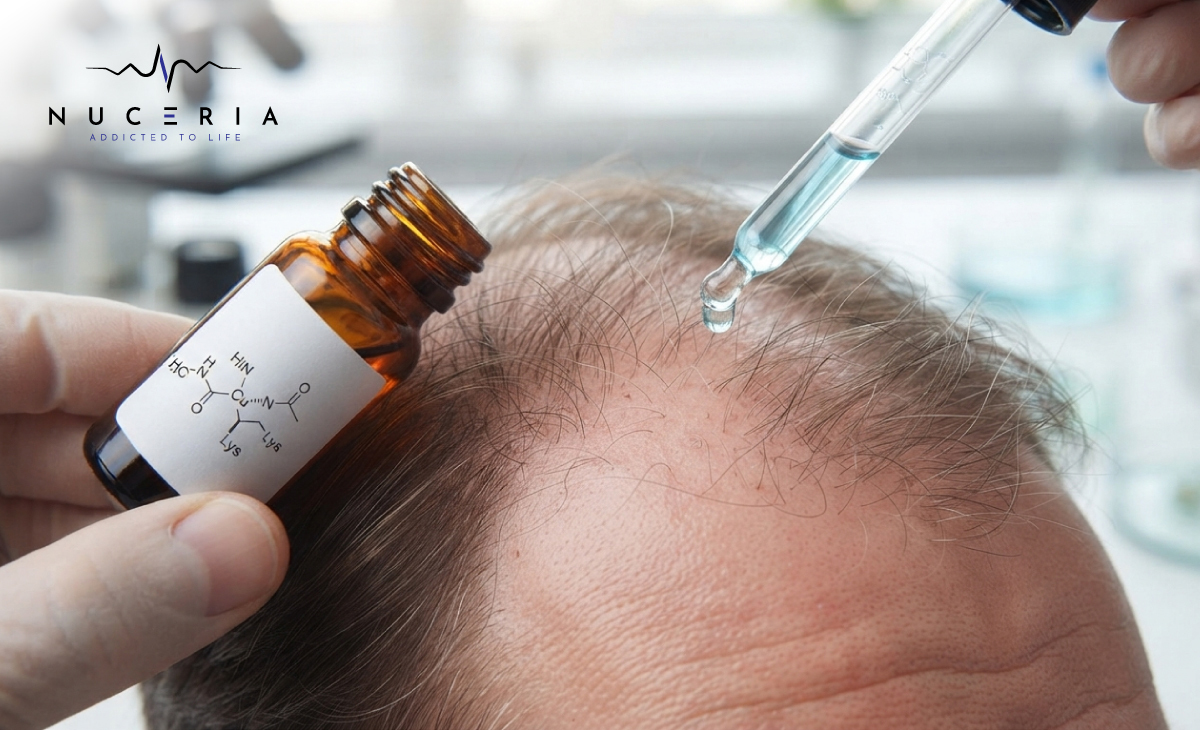
Type "GHK-Cu for hair growth" into Google and you land somewhere between glowing peptide-influencer claims and dermatology forums calling it "promising but unproven." Both are partly right.
If you're deciding whether this copper peptide belongs in your hair loss treatment plan, or whether it's another ingredient riding a supplement-shelf trend, here's what the clinical evidence shows, a realistic timeline, and where testing fits before you spend money on a bottle.
Short version: GHK-Cu is a copper peptide your body makes naturally, and early research, mostly small trials and lab studies, links it to better hair density and follicle health. It's not FDA-approved as a hair loss treatment, it doesn't work through the same pathway as minoxidil or finasteride, and most people see change over three to six months, not three to six weeks. If your hair loss has a hormonal or nutritional cause, testing matters more than the peptide itself.
GHK-Cu, short for glycyl-L-histidyl-L-lysine copper complex, occurs naturally in your body, and levels drop as you age, right alongside the slower tissue repair and thinner hair that come with getting older.
On a cellular level, here's what it does: it activates signaling pathways involved in follicle cycling, triggers new blood vessel growth around the follicle so more oxygen and nutrients reach it, and pushes dermal papilla cells, the cells that decide whether a follicle grows or rests, to multiply instead of die off. It also quiets the low-grade inflammation around follicles that speeds up miniaturization over time.
None of that touches DHT, the hormone finasteride blocks, and it doesn't work through the vasodilation that makes minoxidil effective either. That's the real distinction: GHK-Cu is a different lever entirely, which is why most providers treat it as an addition to a hair regrowth protocol rather than a replacement for either drug.
Fifty to a hundred hairs a day is nothing to worry about, that's just follicles finishing their cycle. It's a jump above that baseline, or shedding paired with visible thinning rather than normal turnover, that's worth paying attention to.
The usual suspects: physical or emotional stress, illness or surgery, hormonal shifts like postpartum recovery or perimenopause, sudden weight loss, and nutrient gaps. Iron, ferritin, and protein deficiencies tend to show up in hair before anywhere else. Doctors call this telogen effluvium, and it behaves differently than androgenetic alopecia, which thins hair in a pattern rather than all at once.
One thing worth being straight about: some people report shedding more right after starting a new topical routine, often labeled a "purge phase" online. There's no clinical study on GHK-Cu that documents this as an expected step, so treat it as anecdote, not something you should expect or wait out. If shedding climbs and doesn't settle within a few weeks, or it comes with thinning you can see, get it checked rather than assume it will resolve on its own.
Every follicle runs through three phases. Anagen is active growth, lasting two to seven years, and it's where 85 to 90 percent of your hair sits at any given moment. Catagen is a short transition, a few weeks, where the follicle shrinks and cuts off from its blood supply. Telogen is the resting phase, about three months, ending when the hair sheds and a new one starts growing in its place.
Androgenetic alopecia shortens anagen and stretches telogen with every cycle, so each new hair comes in finer and shorter than the last. That's the miniaturization pattern any real hair loss treatment, copper peptides included, is trying to slow down or reverse.
The research on copper peptides spans lab work, animal studies, and a handful of small human trials, interesting, but nowhere near the depth of evidence behind minoxidil or finasteride.
In lab studies on human scalp follicles, copper peptide complexes increased proliferation of dermal papilla cells, reduced their rate of cell death, and raised VEGF, a signal that helps build blood supply to the follicle. These effects showed up at very low concentrations, which researchers read as a sign of real biological activity rather than a topical irritation.
Human trials tell a thinner story. Early formulations in the 1990s showed increased hair density and less shedding compared to placebo. One small trial comparing topical GHK-Cu to 5% minoxidil found similar density improvements after six months, a result nobody has replicated at scale, so treat it as a promising lead, not proven equivalence. More recent research in postmenopausal women found real improvements in hair count and shaft thickness with a topical GHK-Cu scalp solution, which matters given how much hair loss research still centers on men.
None of it has gone through the Phase III trials the FDA requires for drug approval, and GHK-Cu is still classified as a cosmetic ingredient, Copper Tripeptide-1 on an ingredient label, not an approved hair loss treatment. That's the honest framing: a mechanism with real science behind it and encouraging early data, not a cure. If you're reading up on this elsewhere, look for PubMed-indexed studies or dermatology journals over brand claims.
Weeks 1 to 4: Scalp condition often improves first, and shedding may start to settle. Don't expect visible density change yet, the biology hasn't caught up.
Weeks 6 to 12: This is usually when the first textural changes show up, especially around the hairline and part.
Months 3 to 6: Most of the improvement documented in existing studies falls here, which tracks with how long a full growth cycle takes to produce a visibly thicker strand.
Past 6 months: Time to reassess with whoever's managing your protocol, keep going, adjust concentration or delivery, or add something else based on how your hair has responded so far.
Consistency and formulation quality matter more than people expect. A degraded or poorly stored GHK-Cu solution looks identical to a potent one while doing almost nothing, one more reason this works better under professional guidance than as a DIY experiment.
Hair loss usually has a specific driver: thyroid dysfunction, low ferritin or iron, androgen sensitivity, or hormonal shifts from menopause or postpartum recovery. A topical peptide that supports the follicle environment won't fix an underlying hormone or nutrient deficiency, and layering treatment on top of an unaddressed cause is how people end up three months in with nothing to show for it.
Testing tells you whether you're dealing with androgenetic alopecia, telogen effluvium, or something else that needs its own treatment before a peptide protocol makes sense. Nuceria's hormone and nutrient testing panel covers the markers most connected to hair thinning, so a healthcare professional can build your plan around the real cause instead of a guess.
If copper peptides do fit your case, Nuceria's peptide therapy program builds GHK-Cu into a protocol shaped by your test results, not a generic bottle with one concentration for everyone.
Shedding 50 to 100 hairs a day is normal. A jump above that usually points to telogen effluvium, from stress, illness, a hormonal shift, or a nutrient gap, or to androgenetic alopecia if it comes with gradual, pattern-based thinning instead of a short spike. Testing is the quickest way to know which one you're facing.
Depends on the cause. Telogen effluvium tied to a specific trigger usually resolves in three to six months once that trigger is gone. Androgenetic thinning doesn't reverse by itself and tends to get worse without some form of treatment.
Early signs, less shedding, better scalp condition, can show up in 8 to 12 weeks. Real density change generally takes 3 to 6 months, since that's how long a follicle needs to complete a full growth cycle.
Some of the most consistent human trial data on copper peptides comes from postmenopausal women, who showed real improvements in hair count and shaft thickness. Because GHK-Cu works through a non-hormonal mechanism, it's especially relevant for women dealing with diffuse thinning, a pattern with fewer approved treatment options than male pattern baldness.
Yes. GHK-Cu works through a different mechanism than DHT-blockers like finasteride or vasodilators like minoxidil, so most providers add it to a broader protocol instead of using it by itself. Microneedling is also commonly paired with a topical GHK-Cu scalp solution to help it absorb. A physician can map out the right combination for your case through Nuceria's peptide therapy program.
If hair thinning has you weighing next steps, a physician consultation with a comprehensive hormone panel is the clearest way to find out what's driving it, and whether GHK-Cu belongs in your plan.
Request an appointment here: https://mynuceria.com or call Nuceria Health at (305) 398-4370 for an appointment in our Miami office.
Check out what others are saying about our services on Yelp: Wellness Center in Miami, FL.