 EN
EN ES
ES
Shopping Cart
Your Cart is Empty
$0.00
View Cart

If you've searched for a way to lift sagging skin without the recovery time of a facelift, a PDO thread lift has probably come up. It's one of the more misunderstood treatments in aesthetic medicine — patients hear "it's like a mini facelift" in one breath and "the threads just dissolve, so what's the point" in the next. Both statements are true, which is exactly why the treatment needs a clearer explanation than most clinics give it.
Here's what a PDO thread lift actually costs in Miami, how long the lift really holds, and where it fits next to filler and Endolift.
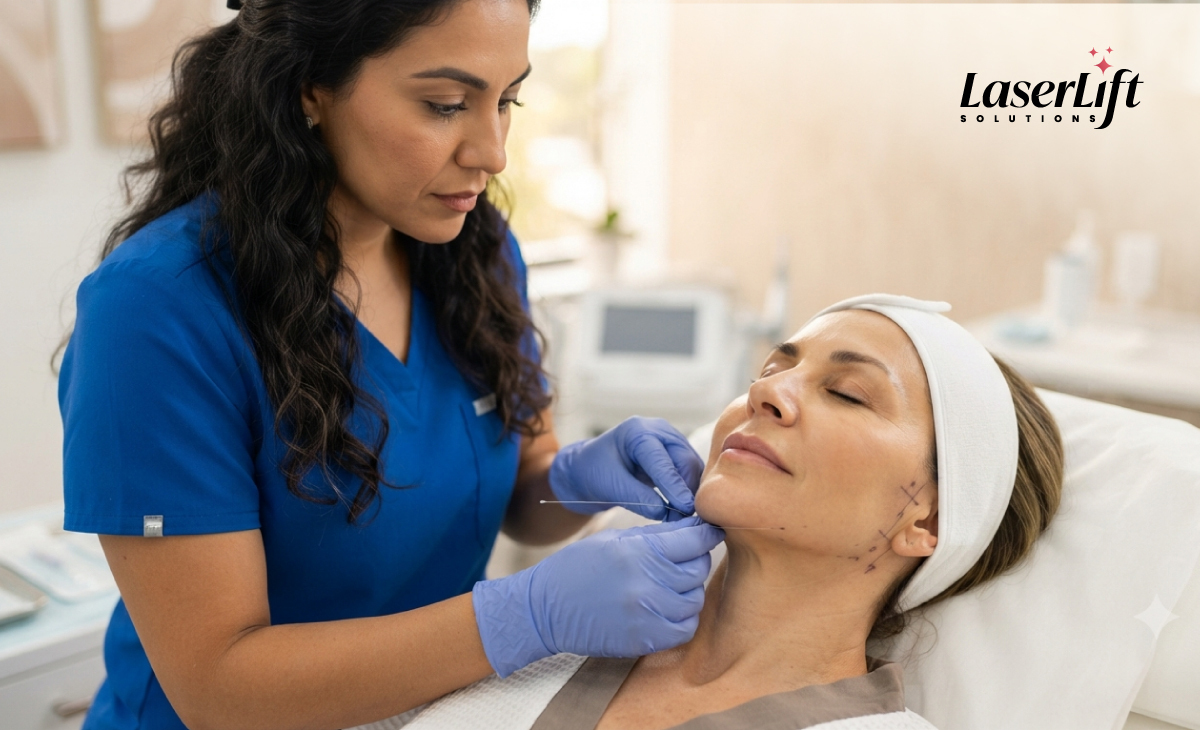
A PDO thread lift is a non-surgical procedure that uses dissolvable polydioxanone sutures, inserted under the skin with a fine needle, to reposition sagging tissue and trigger new collagen production. The threads' barbed or cone-shaped edges grip the underlying tissue, creating an immediate, visible lift, while the material itself is absorbed by the body over four to six months.
That second part is where the treatment does most of its long-term work. As the PDO threads break down, they generate a controlled inflammatory response — the same mechanism behind microneedling or laser resurfacing — that pushes the skin to rebuild its own collagen and elastin. The mechanical lift fades as the thread dissolves, but the collagen response keeps improving skin firmness and texture for months afterward.
Threads are placed most often along the jawline, cheeks, brow, and marionette lines, but the same barbed-thread technique is also used on looser skin on the neck and abdomen, which is why you'll see thread-based treatments offered for both facial rejuvenation and body contouring.
Pricing depends on the treatment area, the number of threads placed, and whether you're addressing one zone or combining several. Below is current, single-area pricing from Nuceria Health's Miami location:
|
Treatment Area |
Price |
What It Addresses |
|---|---|---|
|
Nasolabial Folds & Oral Commissure |
$450 |
Softens the crease running from the nose to the mouth and lifts downturned mouth corners |
|
Smoker Lines |
$300 |
Smooths vertical lip lines caused by repeated pursing and loss of perioral support |
|
Tear Trough |
$450 |
Improves hollowing and mild skin laxity under the eyes |
|
Tummy Lift |
$1,800 |
Uses a grid of threads across the abdomen to lift and firm sagging skin, often post-pregnancy or post-weight-loss |
Most patients don't stop at a single zone. When jawline, mid-face, and brow are treated in the same session — the combination that produces a result closest to a surgical lift — total cost in Miami typically runs $3,000 to $5,000, depending on thread count and the specific areas involved. A single-zone touch-up, like smoker lines or a tear trough refresh, stays well under $500.
The exact number of threads needed varies by how much laxity is present and by anatomy, which is why an in-person consultation, not a price list, gives you the real total. You can book one directly through Laser Lift Solutions.
PDO threads typically produce visible lifting for 12 to 18 months, even though the threads themselves fully dissolve within four to six months. The mechanical lift is what fades first; the collagen the body builds in response continues improving skin firmness and texture for up to two years, which is why results tend to outlast the threads themselves rather than disappearing the moment they're absorbed.
Longevity also depends on the treatment area and the patient's skin quality going in. Thinner-skinned areas like the tear trough tend to show earlier softening of results than the jawline or abdomen, where there's more tissue for the threads to anchor into.
Patients often ask which of the three they need, and the honest answer is that they solve different problems.
Filler adds volume — it fills a hollow tear trough or restores lost cheek projection. Threads reposition tissue that has already dropped. A patient with volume loss but no real sagging usually needs filler alone. A patient whose cheeks and jawline have started to slide downward, with volume that's still present but displaced, is a better candidate for threads. Many patients end up combining both: filler to restore what's missing, threads to lift what's shifted.
Endolift is a laser-based skin tightening treatment that works from beneath the skin using a fine fiber-optic probe, without any anchoring or repositioning. It's a strong option for early skin laxity where the main issue is loose, crepey skin rather than tissue that has visibly dropped. Threads produce a more noticeable, immediate lift because they physically reposition tissue; Endolift produces a subtler tightening with less mechanical intervention.
Who Is a Good Candidate for a PDO Thread Lift?
Threads work best on mild to moderate laxity — the stage where skin has started to soften and slide but hasn't yet developed the deep folds or excess skin that only surgery corrects. Most candidates fall somewhere between their mid-30s and mid-50s, still have reasonably elastic skin, and want to address early sagging without downtime.
Threads aren't the right fit for significant excess skin, since there's no tissue for the threads to lift against — that's a conversation for a surgical consult, not a thread lift. Smokers, patients on blood thinners, and anyone with an active skin infection in the treatment area are also typically asked to wait or explore other options first, since both affect how well the threads hold and heal.
One of the reasons PDO thread lifts are popular is how little downtime they require. Most patients return to normal activities the same day or the next, with mild swelling, bruising, or a tugging, tight sensation for the first several days as the tissue settles around the new thread placement. That tightness is normal and typically resolves within a week to ten days.
For about two weeks, patients are usually advised to avoid extreme facial movements, dental work, facials, and vigorous exercise, since all of these can shift the threads before they've anchored properly. Complications are uncommon when the procedure is done by an experienced provider, but they can include visible dimpling, thread extrusion through the skin, minor asymmetry, or infection — most of which are manageable and resolve with prompt follow-up care. Placement technique matters more here than in almost any other injectable treatment, which is why the provider's experience is worth as much attention as the price.
At Nuceria Health, PDO thread treatments are performed by Samantha Fonte, FNP-BC, a board-certified Family Nurse Practitioner licensed in Florida and Clinical Director of Nuceria Health. For a closer look at what the placement process actually involves, this short video walks through when patients typically start using PDO threads and what to expect at that first session.
Most patients describe pressure and pulling rather than sharp pain. A topical or local numbing agent is applied before threads are placed, and any soreness afterward is usually mild and resolves within a few days.
Yes. Botox and filler are often done in the same visit or spaced a few weeks apart, since they address different concerns — filler restores volume, Botox relaxes muscle movement, and threads reposition sagging tissue. Combining them is common and generally safe.
The lifting effect is visible immediately after placement, though initial swelling can mask some of it for the first few days. The collagen-driven improvement in skin texture and firmness continues to build over the following two to three months.
The PDO material breaks down naturally within four to six months and is absorbed by the body. The lifting effect doesn't disappear at that point — the collagen the threads stimulated continues supporting the skin, which is why visible results typically last 12 to 18 months.
Neither is universally "better" — they treat different stages of aging. A thread lift is a non-surgical option for early to moderate sagging with no downtime, while a facelift addresses more significant excess skin and laxity that threads can't correct. Many patients use thread lifts to delay surgery by several years, not to replace it entirely.
Ready to find out which areas would benefit most from a thread lift? Book a consultation with Laser Lift Solutions or browse the full treatments menu to see how PDO threads compare with other options for your goals.
Request an appointment here: https://mynuceria.com or call Nuceria Health at (305) 398-4370 for an appointment in our Miami office.
Check out what others are saying about our services on Yelp: Wellness Center in Miami, FL.