 EN
EN ES
ES
Shopping Cart
Your Cart is Empty
$0.00
View Cart

You've probably seen the before-and-after photos. A sharper jawline. Tighter skin under the chin. Visible lifting without a single incision. Endolift has earned serious attention in the aesthetic world — and for good reason. The procedure uses laser energy delivered through a micro-fiber to tighten tissue from the inside, and when it works well, the results speak for themselves.
But here's what the highlight reels don't always show: Endolift doesn't produce the same outcome for every person who walks through the door.
That's not a flaw in the technology. It's a reality of how skin, fat, collagen, and aging interact differently in every body. Understanding why Endolift results vary is the single most useful thing you can do before booking a consultation — because the answer has far less to do with the laser and far more to do with you.
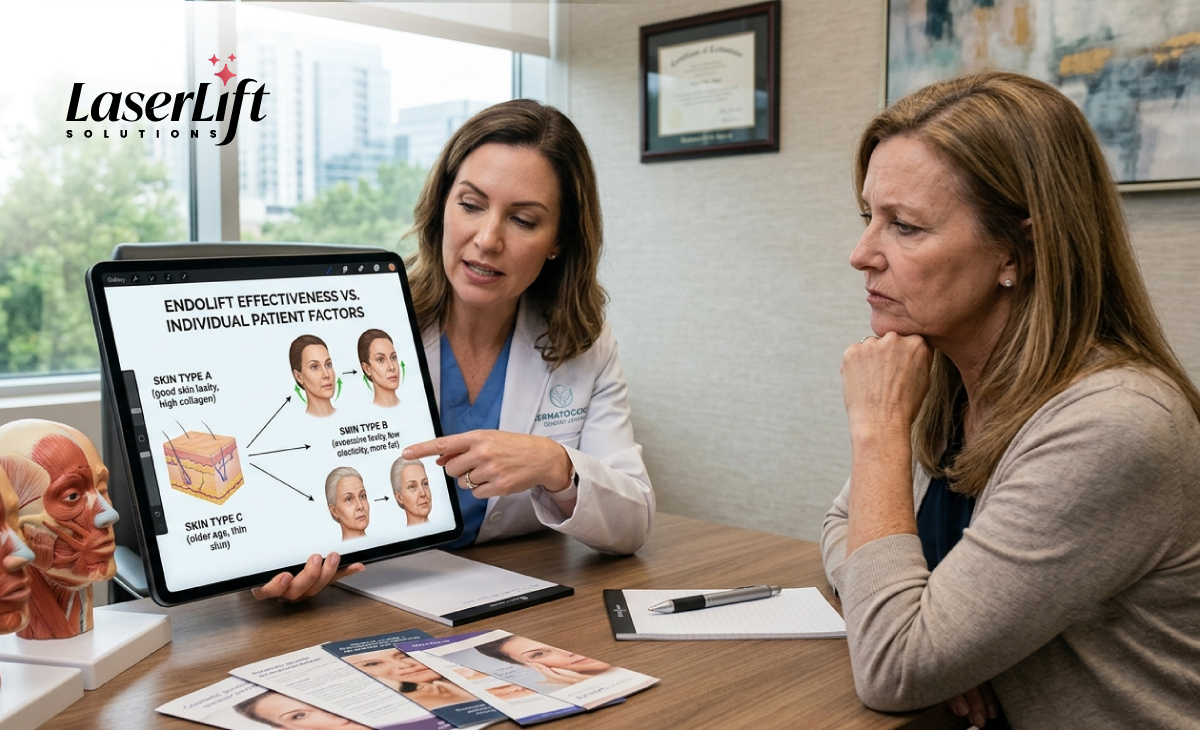
The number one factor that determines whether Endolift delivers noticeable improvement is the condition of your skin before the procedure begins.
Endolift works by sending controlled laser energy beneath the skin's surface. That energy does two things: it causes immediate tissue contraction and it stimulates a longer-term collagen remodeling process over the following weeks and months. Both of those mechanisms depend on your skin's ability to respond — and that ability isn't equal across the board.
Patients with mild to moderate skin laxity tend to see the most consistent improvement. Their skin still has enough structural integrity — enough residual collagen and elastin — to respond to the thermal stimulus. The laser essentially gives the tissue a strong push in the right direction, and the skin has enough elasticity left to follow through.
If you're noticing early sagging under the chin, softening along the jawline, or mild looseness in the lower face, you're likely in this category. These are the cases where non-surgical skin tightening treatments like Endolift tend to shine.
When skin laxity is severe — significant drooping, deep jowling, or very thin and crepe-like skin texture — the tissue has lost too much of its foundational support. Laser energy can still reach the target area, but the skin's capacity to contract and rebuild is diminished. In these situations, the results may be subtle or underwhelming compared to what the patient hoped for.
This doesn't mean Endolift is useless for advanced aging. But it does mean that a responsible provider will have an honest conversation about what's realistically achievable, and whether a different approach — or a combined approach — might serve you better.
It's tempting to draw a clean line: younger patients get better Endolift results, older patients don't. The reality is more nuanced than that.
Biological age and chronological age don't always match. A 55-year-old who has protected their skin from sun damage, maintained good nutrition, and has strong collagen production may respond better than a 40-year-old with a history of smoking, chronic sun exposure, and poor skin health.
What matters is your skin's biological capacity to regenerate. Collagen synthesis slows with age — that's unavoidable — but the rate of decline varies dramatically based on genetics, lifestyle, and cumulative skin damage. A consultation that includes a thorough skin assessment is the only reliable way to gauge where you actually stand. If you're curious about your candidacy, reviewing our frequently asked questions about laser lift procedures is a solid starting point.
The submental region — the area under the chin — is one of the most requested treatment zones for Endolift. It's also one of the most variable in terms of outcomes, and there are specific anatomical reasons for that.
Under chin fullness can come from different sources. In some patients, it's primarily a fat accumulation issue. In others, it's loose skin. In many, it's a combination of both, sometimes with a weakened platysma muscle contributing to the appearance.
Endolift addresses tissue laxity and can reduce small fat deposits through lipolysis. But if the primary issue is a larger volume of submental fat rather than skin looseness, the procedure alone may not produce the dramatic "snatched" look patients are after. Similarly, if muscle banding is the dominant concern, a laser-only approach has its limits.
That's why a targeted assessment of your under chin concerns matters so much. What looks like the same problem on the outside often has very different causes beneath the surface — and the cause determines the solution.
At the core of every Endolift result is collagen. The laser energy triggers a wound-healing response that, over time, produces new collagen fibers and tightens existing ones. This remodeling phase is where the most significant visible improvement happens — typically between two and six months post-treatment.
But collagen production is deeply individual.
Some patients are strong collagen producers. Their bodies mount a robust healing response, and the tightening continues to develop well after the procedure. Others have a more muted biological response. Genetics play a role. So do nutritional factors, hydration, hormonal status, and overall health.
This variability explains why two patients with seemingly identical skin conditions can have noticeably different outcomes. It's not that the treatment was performed differently — it's that their bodies processed the stimulus differently.
Several factors are known to impair collagen synthesis and can directly affect how well Endolift works:
Smoking constricts blood vessels and reduces oxygen delivery to healing tissue. It is one of the single biggest predictors of a weaker treatment response.
Chronic sun damage degrades existing collagen and impairs the skin's ability to produce new fibers in response to treatment.
Certain medications, particularly long-term corticosteroid use, can slow tissue repair and collagen formation.
Nutritional deficiencies — especially in vitamin C, zinc, and protein — limit the raw materials your body needs to build collagen.
Poorly managed chronic conditions like diabetes can affect healing at every level.
None of these factors make Endolift impossible. But they do create headwinds, and patients with multiple suppressive factors should set expectations accordingly.
Endolift is a technique-sensitive procedure. The laser fiber is inserted through a tiny entry point and guided beneath the skin to deliver energy at precise depths and locations. The quality of that delivery — how evenly the energy is distributed, how accurately the treatment zones are targeted, how well the provider reads the tissue response in real time — varies significantly between practitioners.
A skilled provider adjusts their approach based on what they feel and see during the procedure. Tissue thickness differs across zones. Fat distribution isn't uniform. The depth that works in one area of the jawline may be wrong for the submental space. These are judgment calls that happen in real time, and they require hands-on experience with the specific technology.
When patients say "Endolift didn't work," it's worth asking whether the issue was the procedure itself or how it was performed. At Laser Lift Solutions, provider expertise is treated as a core part of the equation — because it is.
Here's something that gets lost in aesthetic marketing: managing expectations isn't about lowering the bar. It's about defining what success actually looks like for your face, your anatomy, and your goals.
Endolift is a non-surgical procedure. It produces real, visible tightening. But it does not replicate the results of a surgical facelift. Patients who walk in expecting a dramatic transformation equivalent to going under the knife will almost always feel the result fell short — not because the treatment failed, but because the expectation was misaligned with what non-surgical technology can deliver.
The best outcomes happen when patients understand the spectrum of possibility before treatment day. That conversation — an honest, specific, no-pressure discussion about what you're likely to see — is arguably as important as the procedure itself.
If you want to understand what's realistic for your specific concerns, the most productive step is to explore our treatment options and schedule a consultation where your anatomy, skin quality, and goals are evaluated together.
The Endolift procedure itself takes under an hour. The collagen remodeling that follows takes months. What you do during that window has a measurable effect on your final outcome.
Patients who protect their skin from UV exposure, maintain adequate hydration, eat sufficient protein, avoid smoking, and follow their provider's aftercare instructions consistently report better and longer-lasting results. This isn't marketing language — it reflects the biology of tissue repair.
Conversely, patients who return to heavy sun exposure, smoking, or neglect aftercare often see their results plateau earlier or fade faster than expected.
Think of Endolift as a strong signal sent to your body. Your post-treatment habits determine how clearly your body receives and acts on that signal.
One reason Endolift doesn't meet expectations for certain patients is that their concern requires more than one modality to address properly.
A patient with significant submental fat and moderate skin laxity may benefit from combining Endolift with targeted fat reduction. Someone with surface-level skin texture issues and deeper laxity might need the laser lift paired with a resurfacing treatment. Volume loss in the mid-face can make lower face laxity appear worse than it is — and no amount of skin tightening will fix a volume problem.
Experienced providers think in terms of the full picture, not a single tool. If Endolift alone isn't the right fit, that's not a failure — it's useful diagnostic information that points toward a plan that will actually work.
You can learn more about under chin tightening and how it can be tailored or combined for more complex concerns.
Endolift results depend on individual factors including skin laxity severity, collagen production capacity, lifestyle habits, the underlying cause of the concern, and provider technique. Patients with mild to moderate laxity and healthy collagen response tend to see the strongest results. Those with advanced sagging, significant fat deposits, or impaired healing may experience more limited improvement.
The strongest candidates have mild to moderate skin laxity, maintain reasonably healthy lifestyle habits, are non-smokers or willing to stop before treatment, and have realistic expectations about non-surgical outcomes. A thorough in-person assessment is the only reliable way to determine candidacy.
Some tightening is visible immediately due to tissue contraction during the procedure. The more significant improvement develops over two to six months as new collagen forms and matures. Final results depend on the individual's collagen response and post-treatment care.
No. Endolift is a non-surgical alternative that produces meaningful tightening without incisions, general anesthesia, or extended downtime. It's a strong option for patients who aren't ready for surgery or whose concerns don't warrant it. But it does not replicate the degree of lifting and repositioning that surgical intervention achieves.
A responsible provider will tell you. During a consultation at Laser Lift Solutions, if your anatomy or skin condition suggests that Endolift alone won't meet your goals, you'll receive an honest recommendation — whether that means a combined treatment plan or a different approach entirely.
Yes, significantly. Smoking impairs blood flow and oxygen delivery to skin tissue, both of which are critical for the collagen remodeling process that drives Endolift results. Patients who smoke typically see diminished outcomes compared to non-smokers.
Considering Endolift but not sure if it's right for you? The answer starts with an honest assessment — not a sales pitch. Reach out to Laser Lift Solutions to schedule a consultation built around your skin, your anatomy, and your actual goals.
Request an appointment here: https://mynuceria.com or call Nuceria Health at (305) 398-4370 for an appointment in our Miami office.
Check out what others are saying about our services on Yelp: Wellness Center in Miami, FL.