 EN
EN ES
ES
Shopping Cart
Your Cart is Empty
$0.00
View Cart

Patients comparing Endolift vs mini facelift are usually asking a deeper question: can non-surgical tightening give me enough improvement, or has my face reached the point where surgery makes more sense?
That is the right question.
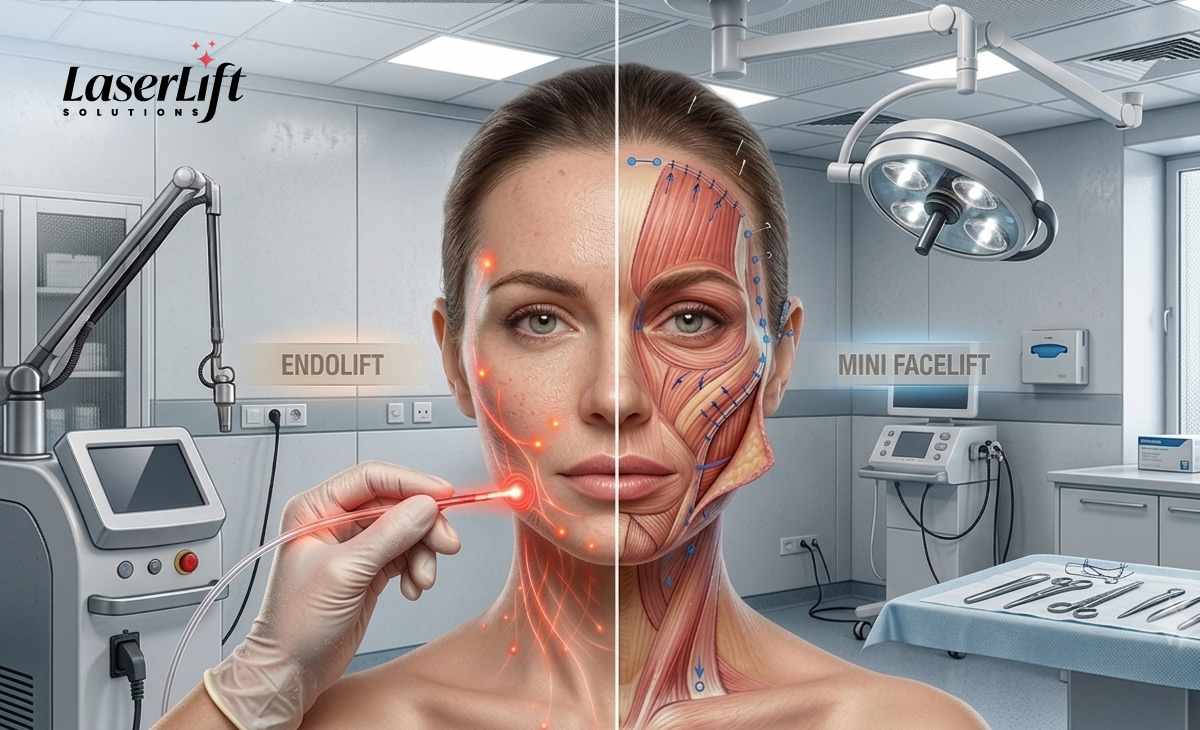
Endolift and a mini facelift do not correct the same level of facial aging. Endolift is a minimally invasive laser treatment used for early laxity, jawline softness, mild jowling, under-chin fullness, and early neck looseness. A mini facelift is a surgical procedure designed to reposition deeper tissue and correct more advanced lower-face sagging.
At Nuceria Health in Miami, Samantha Fonte, FNP-BC, evaluates whether Endolift is a realistic first step or whether the patient’s anatomy needs a different path. The goal is not to push every patient toward a non-surgical treatment. The goal is to match the treatment to the tissue.
Patients who want to understand how Endolift is performed at Nuceria can review the main Endolift treatment in Miami page before comparing it with surgical options.
The main difference between Endolift and a mini facelift is not just “non-surgical vs surgical.” The real difference is the depth and degree of correction.
Endolift works beneath the skin using a thin optical fiber that delivers controlled laser energy into the subdermal layer. It can support tissue tightening, collagen remodeling, and contour refinement in selected areas such as the jawline, lower face, under-chin area, and upper neck.
A mini facelift works differently. It surgically repositions tissue, usually through incisions around the ear. The American Society of Plastic Surgeons describes facelift surgery as a procedure that can improve visible signs of aging in the face and neck, including sagging skin, deep fold lines, jowls, and excess fat or loose skin in the neck. Patients researching the surgical side can review the ASPS overview of facelift surgery.
That distinction matters because Endolift can refine tissue. A facelift can reposition it.
If the patient has mild jawline blur, early laxity, or a small amount of under-chin fullness, Endolift may be appropriate. If the patient has advanced jowling, significant skin excess, or lower-face descent, a mini facelift may be more realistic.
Endolift may be enough when the concern is early and the tissue still has good response potential.
This is the patient who looks in photos and notices that the jawline is not as crisp as before, but the lower face has not fully descended. The neck may look slightly soft. The area under the chin may feel heavier. The lower face may look less defined, but not dramatically sagging.
Endolift may fit patients with:
This type of patient is not usually looking for a new face. They want better definition, a cleaner jawline, and a sharper transition between the chin and neck.
Nuceria’s Endolift service page notes that the treatment is commonly used for a soft jawline, early jowls, double chin, and neck laxity, with results developing gradually over three to six months. That makes Endolift in Miami a logical starting point for patients who are not ready for surgery but want more than surface-level skin treatments.
A mini facelift may be more appropriate when the lower face has moved beyond mild laxity.
That usually means the issue is no longer only skin quality or subtle contour blur. The tissue has started to descend. Jowls are more visible. The lower face may look heavy at rest, not only in certain angles or photos. The neck may have loose skin that cannot contract enough with laser-based treatment alone.
A patient may need a surgical opinion if they have:
This is where Endolift can be oversold. A non-surgical treatment should not be positioned as a substitute for surgery when the anatomy clearly needs surgical correction.
Endolift can be valuable for the right candidate. It becomes disappointing when it is used on a patient whose expectations or tissue condition require more correction than laser tightening can provide.
Early jowls are one of the most common reasons patients compare Endolift with a mini facelift.
Endolift may help when jowling is mild and connected to early laxity or jawline softening. The goal is not to pull the face upward like surgery. The goal is to tighten selected tissue, support collagen remodeling, and make the jawline look cleaner.
This can be useful when the jowl is just beginning to blur the border of the jaw. It is less useful when the jowl has already become heavy, folded, or clearly descended.
The best candidates for Endolift for mild jowls usually still have:
If the jowl is advanced, Endolift may not deliver the level of correction the patient wants. That does not make Endolift weak. It means the treatment was built for a different stage of aging.
Surgery is advantageous when the issue is structural descent.
A mini facelift can reposition tissue in a way that non-surgical tightening cannot. This matters when the lower face has significant sagging, deeper folds, or jowls that need lifting rather than mild tightening.
Patients sometimes want to avoid surgery at all costs. That is understandable, but avoidance should not replace clinical judgment. If the face needs tissue repositioning, a non-surgical treatment may only create a partial result.
This is especially important for patients who are comparing costs. Endolift may cost less than surgery, but a lower price does not make it a better option if it cannot solve the actual problem. The most expensive plan is often the one that starts with the wrong treatment.
Patients comparing non-surgical pricing can review Nuceria’s guide on Endolift cost in Miami, which explains how treatment area, provider experience, and case complexity affect the quote.
Recovery is one of the biggest reasons patients consider Endolift before surgery.
Endolift usually involves social downtime rather than surgical recovery. Patients may experience swelling, tightness, tenderness, and bruising, but many return to light activity quickly. Results develop gradually as swelling settles and collagen remodeling progresses.
A mini facelift usually involves a more formal recovery period because it is a surgical procedure. There may be incisions, sutures, bruising, swelling, activity restrictions, and a longer healing timeline. The tradeoff is that surgery can create a stronger correction in the right candidate.
This difference does not make one option better. It changes which option fits.
A patient who needs subtle lower-face refinement may not want surgical downtime. A patient who needs meaningful tissue repositioning may accept surgical downtime because the correction is more aligned with their anatomy.
For Endolift-specific healing expectations, Nuceria’s Endolift recovery timeline explains how swelling, tightness, and visible improvement can evolve after treatment.
Many patients compare Endolift and a mini facelift first by cost. That is understandable, but it can lead to poor decisions.
The lower-cost option is not automatically the smarter option. The smarter option is the one that fits the anatomy.
If a patient has mild laxity and good skin response, Endolift may be the more efficient plan. It can improve jawline definition and early neck softness without sending the patient into surgery too early.
If a patient has advanced sagging and significant tissue descent, choosing Endolift only because it is less invasive may lead to disappointment. The patient may spend money, wait months for collagen remodeling, and still need surgery later.
The better cost question is not “Which treatment is cheaper?” It is “Which treatment has the highest probability of solving the actual problem?”
That is why consultation matters. A good candidacy assessment prevents under-treatment and over-treatment.
Endolift may delay the need for a mini facelift in selected patients, but it should not be sold as a guaranteed replacement.
If the patient has early laxity, mild jowling, or softness of the jawline, Endolift may help improve contour and support the tissue before surgery becomes necessary. For some patients, that may extend the timeline before they consider a surgical lift.
But if the patient already has advanced lower-face sagging, Endolift may not meaningfully delay surgery. In those cases, surgery may already be the more direct route.
This is where honest language matters. Endolift can be a strong bridge treatment. It is not a facelift without incisions.
Patients who want to understand whether their age and skin quality are suitable for Endolift should wait until the final “Best Age for Endolift” URL is live, then internally link to it from this section. Do not link to a broken or unpublished URL.
Under-chin fullness is not always a facelift problem.
If the concern is a small pocket of submental fat, mild skin looseness, or a blurred chin-neck angle, Endolift may be a more appropriate first step than a mini facelift. It can address selected fat and tissue laxity in the under-chin area without surgical lifting.
A mini facelift may be more relevant if the under-chin issue is part of broader lower-face sagging, advanced neck laxity, or excess skin that needs repositioning or removal.
This distinction matters because patients often use the same phrase—“double chin”—to describe very different anatomy.
One patient may need under-chin contouring. Another may need neck surgery. Another may need weight loss, skin tightening, or a staged plan.
For a more specific breakdown, Nuceria’s guide to Endolift for double chin in Miami explains when Endolift is appropriate for under-chin fullness and when another treatment may be better.
At Nuceria Health, Samantha Fonte, FNP-BC, evaluates whether Endolift is the right first step by assessing the entire lower face, not just the treatment area.
That includes jawline structure, jowl severity, neck laxity, under-chin fullness, skin elasticity, facial proportions, weight stability, medical history, prior procedures, downtime tolerance, and the patient’s definition of a successful result.
This matters because two patients can request the same treatment but need different plans.
A patient with early softening of the jawline may be a strong Endolift candidate. A patient with advanced lower-face descent may need a surgical opinion. A patient with under-chin fullness and firm skin may need a different contouring approach.
Endolift is operator-dependent. The outcome is shaped by patient selection, treatment mapping, fiber placement, energy control, and restraint. Nuceria’s main Endolift page notes that Samantha Fonte, FNP-BC, performs Endolift at Nuceria and focuses on jawline contouring, lower-face support, and neck tightening.
Patients searching for a mini facelift alternative in Miami are usually not opposed to surgery in the long term. They are trying to understand whether they can get a visible improvement without choosing surgery too early.
That is a reasonable search.
Endolift may make sense as a mini-facelift alternative when the patient has early laxity, mild jowling, under-chin fullness, or softness of the jawline. It is less invasive than surgery and may be better suited for patients who prefer refinement rather than repositioning.
But the term “alternative” needs to be defined. Endolift is not an equal replacement for a mini facelift in advanced cases. It is an alternative for selected patients whose anatomy still fits non-surgical correction.
The best plan protects the patient from both extremes: performing surgery too early and delaying non-surgical treatment.
The simplest way to compare Endolift and a mini facelift is by stage.
Endolift usually fits earlier-stage concerns: mild laxity, jawline blur, early jowls, under-chin fullness, and neck softness where the skin can still respond.
A mini facelift usually fits more advanced concerns: tissue descent, stronger jowling, loose skin, deeper lower-face folds, and sagging that needs repositioning.
The right choice depends less on age and more on tissue condition.
A patient in their 40s may need surgery if laxity is advanced. A patient in their 50s may still qualify for Endolift if the tissue quality is strong and the concern is localized. A patient in their 30s may not need either if the issue is too mild.
That is why diagnosis matters more than the treatment name.
Choose Endolift if the goal is mild to moderate tightening, jawline refinement, under-chin contouring, or early lower-face support without surgery.
Consider a mini facelift if the goal requires tissue repositioning, stronger jowl correction, or meaningful improvement in advanced sagging.
The wrong choice usually comes from trying to force one treatment to do the job of another.
Endolift is not weak because it cannot replace surgery in advanced cases. A mini facelift is not excessive when the anatomy genuinely needs surgical correction. The best result comes from choosing the right tool at the right time.
For patients in Miami who want a provider-led evaluation, review the full Endolift treatment at Nuceria Health and schedule a consultation to determine whether non-surgical tightening is appropriate for your anatomy.
Endolift can be an alternative to a mini facelift for selected patients with mild to moderate laxity, early jowls, or softness of the jawline. It should not be considered a full replacement for surgery in advanced sagging or significant tissue descent.
Endolift is better for patients who need non-surgical tightening and contour refinement. A mini facelift is better for patients who need surgical tissue repositioning. The better option depends on anatomy, laxity, goals, and tolerance for downtime.
A good Endolift candidate usually has mild jawline softness, early jowls, mild under-chin fullness, early neck laxity, good skin elasticity, and realistic expectations. Patients with advanced sagging may need a surgical consultation.
Endolift usually involves shorter social downtime, with swelling, tightness, tenderness, or bruising possible after treatment. A mini facelift involves surgical recovery, which may include incisions, sutures, swelling, bruising, and longer activity restrictions.
Endolift may help early jowls when the issue is mild laxity or jawline softening. It is not designed to correct advanced jowling or significant tissue descent.
Endolift can be a good alternative to a mini facelift in Miami for patients who want lower-face refinement without surgery and still have sufficient skin quality to respond. It is not the right alternative for every patient.
Some patients may benefit from Endolift before considering surgery, especially when laxity is early, and the goal is refinement. Patients with advanced sagging may be better served by a surgical opinion first.
Request an appointment here: https://mynuceria.com or call Nuceria Health at (305) 398-4370 for an appointment in our Miami office.
Check out what others are saying about our services on Yelp: Wellness Center in Miami, FL.